Artöm Mazurchak

I live in Cyprus. I built Biz-cen.ru in Russia, Lashoestring.com in the UK, and Vasterra.com globally. I run a Telegram channel. For contact — email.

JTBD Interviews for a Product: From Guesswork to Clear Segments and Decisions

When a product grows, the team almost always ends up with different versions of reality. Marketing sees one audience, product sees another, support sees a third. Then we argue about segments based on intuition, the loudest voice wins the roadmap, and research stays in a folder and changes little.

In this case study, I show how I built one shared picture using LTV data, ABCD segmentation, and deep JTBD interviews. Then I turned the results into clear segments, customer language, and practical decisions for the product and communication. I also explain how I used AI live translation so I could talk to customers in their native language(Spanish), even when I do not speak it.

I do not share the company name and the exact numbers on purpose. In the screenshots, the data is fictional, but it still shows the right meaning.

Goal of the Research

Here is what I needed to do:

  • Stop inventing audience segments, and build them from real facts and real user voices.
  • Agree on the focus: who we serve best, and what value we deliver better than competitors.
  • Understand which customers actually keep the economics working.
  • Create artifacts that help other departments act and align with the needs of a particular segment.
At the start, we agreed that you can grow business metrics and beat competitors through the right segmentation.

My Pre-Interview Setup

For research like this, I build the process from scratch: first I align terms and expectations → then I collect facts → after that I write testable conclusions and turn them into concrete decisions with clear priorities. This removes subjectivity and makes it easier to pass the result between teams.

The project had four steps:

  1. Aligning views inside the company.
  2. Quantitative segmentation by LTV and ABCD segmentation.
  3. Deep interviews in JTBD logic.
  4. Writing clear customer jobs.

Step 1. Running an Internal Team Workshop Alignment

At the start, I ran a workshop where I set the JTBD frame:

People choose a product as a tool to solve a specific task. It is important to see the context, triggers, success criteria, trade-offs, and alternatives — not a list of desired features.

Then the team described its current view of segments: who they see as key, what they promise them, where the product magic is, and which jobs it covers. We compared the maps, captured the differences, and agreed: from here we test hypotheses with data and interviews, not with personal beliefs.

Step 2. Economics: LTV and ABCD segmentation

To make sure interviews did not turn into talks with random people, I started with the customer base. Using seven months of data, I split users by LTV ranges and calculated group size, average number of purchases, revenue, average LTV.

The analysis showed that customers with LTV 200–500 bring 56% of revenue. The goal of the research was to understand why they choose the product and what tasks / jobs they use it for, so we can learn how to attract and retain this group.
I applied the ABCD framework to the collected data.

This is where the first “cold shower” happened, and it made the discussion clear right away: a clearly defined share of LTV customers brought most of the revenue. That gave the research an honest focus. We wanted to understand:

  • who these people are;
  • why they choose us;
  • how to scale this success without drowning in endless service for low-value customers.

Step 3. In-Depth Customer Interviews to Identify Segment Patterns

The goal of the interviews was to understand why the client chose our product:

  • what happened before the purchase;
  • what became the trigger;
  • what options they compared;
  • where they hesitated;
  • when the feeling appeared: “aha, this works”;
  • how the customer defines success.

In each session, I captured the profile, trigger, aha moment, problems, customer jobs, and signals of disappointment. At the same time, I collected live quotes: the phrases people use to describe their goal and progress. Later, this language works great in marketing, onboarding, and product messaging.

I ran the interviews in Google Meet, and I recorded and transcribed them with Loom. Some conversations were in Spanish: I used a new Google AI service that does live, two-way translation in real time from Spanish to English and back.

An example interview where I talk to a customer from Spain without speaking Spanish. In the video, you can see how an AI-based two-way translator works.

Timing made one thing clear fast: 90 minutes gives better quality than 60. People have time to move past general phrases and get to the real reasons and trade-offs.

I planned to do 25 interviews. But by the 20th, I saw that the key motives and conflicts were repeating — so I stopped earlier.

In total, I did 23 interviews: 16 in German and 7 in Spanish. I captured thoughts and conclusions from each session on an online board — in the end, it became a full knowledge base.

Step 4. Defining Three Key Segments and Their Qualification Criteria

After the interviews, I built the segmentation so it works in real life. Not abstract portraits, but criteria that help the team confidently assign a customer to a group and understand how to work with them. I looked at:

  • goals and motivation;
  • risk attitude;
  • experience;
  • discipline;
  • routines and rituals;
  • learning and decision-making styles.
This is how three segments appeared, with different motives. Each has its own entry triggers, its own aha moment, and its own criteria for what is valuable.

Inside the segments, I saw repeating patterns: how people describe the goal, how they measure results, and which limits they see as critical.I put them into a separate block so other departments could better understand what our clients think about and how they make decisions.

Another artifact was a matrix of selection criteria and reasons why some customers choose competitors. It connected the customer voice with the market picture and helped us define clear points of comparison across segments.

How I made the results accessible to the whole company

One typical research risk is that knowledge stays with the researcher and dies when the context changes. To avoid that, I built an internal AI agent based on the project materials: transcripts, tagging, insights, and also external sources. Teams could ask questions and get answers grounded in real interviews and quotes, including in different languages.

This sharply increased the visibility of the knowledge portfolio: product, marketing, and support started to speak the same language and return to the source data faster when decisions were disputed.

Simulation game: “How will AI develop over the next 5 years?”

At the weekend, we spent two days on a simulation all about how AI might evolve over the next five years. There were 36 players involved. The game itself is a test and workout for skills like leadership, dealing with uncertainty, negotiation, building coalitions and cascading teamwork. Last year, I took part in a similar simulation, but that one focused on a geopolitical conflict.

Here’s how the game worked

Everyone was split into teams, each representing a key player in the market:

  1. Established IT leaders – companies like Google, Microsoft, Meta and Alibaba;
  2. AI startups – like Anthropic and OpenAI;
  3. Chipmakers – companies like IBM and Nvidia;
  4. Venture investors -GP and Standard Investments;
  5. Conglomerate – X, led by Musk;
  6. Regulators, the press and the courts.

35 people were split into teams and each person got assigned a role with details like personal goals, company status, industry position, team relationships, company ownership percentages, etc.

Each team member had their own “stats” like the number of people on their team, computing power, budget, accounts receivable and more.

There were 5 rounds, each lasting about an hour and a half. You could do pretty much anything: lure talent away from other companies, sue someone or get regulators involved, raise funds to build new factories to boost computing power. Any move was allowed, but moderators, the court or regulators could step in and veto an action.

At the end of each round, all the agreements made were handed over to the moderator, who compiled the results into a spreadsheet for each company. The spreadsheet tracked key stats that changed during the round, covering everything from team size to available cash.

The main goal for each team was to reach singularity, they used a Scrabble-like mechanic for that. At the end of each round teams got letter tiles, the number of letters depended on team size and computing power. But the exact formula of how letters were awarded was a secret, known only to the organizers and it wasn’t a straightforward calculation.

Post-game takeaways

1. The role you got is just a formality.
My role was a team lead at a company like OpenAI, not a top position. When I started negotiating with other teams, they asked what my position was and if I could make decisions. But I explained I was there representing the team and my role didn’t really matter. Very good. When it came time to run for president, I thought, there are already bigger names in the game, like Musk, so why even bother? Roles are just labels, both in the game and in real life. But it’s easy to use them as an excuse.

2. Always lead, always.
At the start of the game, we spent way too much time explaining what everyone planned to do. But as soon as we nailed down a clear vision of the goal and just got moving. Coming in with a plan and sharing it with the team really helped. I think the long talks happened because people were afraid to work with other teams and didn’t want to take responsibility alone. They wanted to share it so no one felt fully in charge.

3.If you don’t get the result you want, don’t overthink it – keep going.
When my or the team’s actions didn’t pay off, I got caught up in my emotions. But a few times when I pushed through and made an extra effort, things surprisingly turned out well. I’m more convinced than ever that keeping a cool head gets you results faster.

4. Look at your social connections before you start and use them.
At the start of the game only three teams had computing power. The first two teams I asked didn’t want to work with me. But the third team had someone I already knew and they agreed to cooperate. I’m sure the trust we built before the game helped a lot. You should use this kind of trust and manage it, both in the game and in real life.

5. Keep the whole game in mind while working on the current round.
It’s normal to want quick, predictable results. But if you only focus on the short term, your options get limited. When you plan for the long game, looking ahead several rounds, you open up more possibilities and better chances to succeed. For example, we started building a coalition in the first round and didn’t finish it until the third, but that gave us a lead over the other teams.

6. When things are uncertain, focus on finding opportunities.
In uncertain situations with lots of different interests, it’s easy to just stick to your own goals – your role makes them clear and it feels simpler that way. But if you pause for a second, you’ll see everyone starts like that and the only way to win is by working together. So from the very beginning, look for chances to boost both your position and the other team’s. In the end, the team that began building a coalition right from round one won.

7. First, get the context – then take action, but don’t take too long.
The roles and rules are detailed and you get all the info just before the game starts, so it’s impossible to understand everything right away. My team spent time trying to figure it all out, but we ended up talking too much and wasting time we could use to do something. You learn the context by engaging with others, not by staying stuck in your own little world.

8. Keep taking action until you get a confirmed result.
When several teams are involved in a deal, it can feel like you’ve already agreed and can move on to the next step. But deals have fallen apart more than once right at the signing. So until the agreement is actually signed, don’t get distracted, follow through all the way to the end.

9. Split up the responsibilities.
More than once, our whole team went to negotiate with another group, all of us listening at the same time, which wasn’t very efficient. In the game, just like in real life, there are lots of tasks and layers to handle. To work better, it’s smarter to divide the responsibilities and work on things at the same time. On the second day we did that and our team got way more efficient.

10. Stay in sync and make sure everyone’s on the same page.
When signing some deals, it turned out that key people had different ideas about how things should work and that ended up breaking the deal. The main points and strategy need to be clearly explained from the beginning.

Thanks to Marat Atnashev, Timur Atnashev and their team for organizing the game.

How venture studios help big companies survive the AI era

A venture studio is an organization focused on building and scaling startups. Unlike accelerators, studios are typically specialized in a specific industry and offer deep operational support to the startups they launch.

Sometimes, large corporations launch internal venture studios. The biggest challenge they’re trying to solve is “the innovator’s dilemma”. This concept, described by Clayton, explains how big companies often miss out on new markets and breakthrough technologies because they’re too focused on protecting their current market share. And right now, many of those breakthrough technologies are connected with AI.

Venture studios are also often founded by serial entrepreneurs with deep expertise in a particular vertical. Their experience gives them an edge in selecting the right projects to launch and in providing the kind of hands-on support startups need to succeed in that specific field.

Take, for example, companies that made traditional hard disk drives. When SSDs first hit the market, they were expensive and the demand was small. But as costs dropped and the market exploded, many HDD makers who failed to invest in SSD technology early enough went out of business. Classic case of “the innovator’s dilemma” in action.

Key Traits of a Venture Studio

1. Industry Specialization

One major trait of venture studios is their focus on a single domain like health, finance, developer tools, etc. Specialization makes it easier to choose which startups to launch and how to support them. Startups within the same vertical tend to face similar challenges, so operational help is more relevant and effective.

Moreover, investing in specific infrastructure costs less than trying to cover multiple verticals at once. Once a few startups are up and running, they can share learnings, data and network. That speeds up experimentation and improves decision-making across the board.

A great example is Askona, a company that makes sleep products, launched a venture studio focused on wellness and recovery. Every startup in that studio benefited from Askona’s deep knowledge in the field.

2. Building Repeatable Processes

Industry focus gives studios clarity on what phases a startup goes through and that helps build the right infrastructure to guide teams through each stage. Studios create best practices, frameworks and roadmaps to help startups move faster.

At this point, it’s all about finding the balance between freedom and structure. Founders need room to think like entrepreneurs, take risks and move fast. At the same time, proven processes help tackle the common challenges every startup faces more efficiently. The studio’s operational support should guide the direction, not hand out a strict playbook.

That support often includes:
Operational support typically includes:
A. Identifying a big enough market and applying the right evaluation methods
B. Structuring the idea discovery process for future projects
C. Selecting key metrics and developing strategies to move them
D. Providing resources for hiring, marketing, product expertise and CustDev.

3. Fail Really—REALLY Fast

Having established processes in place allows startups to move faster from the very beginning. Unlike independent startups, founders inside a venture studio don’t have to constantly worry about fundraising, they can stay focused on building and growing the company.

So, if you define clear target metrics for each stage of a startup’s development, you can quickly see whether the project is on track to find PMF. If the startup doesn’t hit its targets, it’s easier to shut it down and move on. So venture studios bring both discipline and speed to startup development.

4. Skin in the Game

One of the core risks Clayton highlights in The Innovator’s Dilemma is what happened when large companies set up R&D centers (the early predecessors of today’s venture studios). A common mistake was staffing those centers with teams from the parent company. Along with their skills, they brought the mindset and values of an established corporate environment rather than an entrepreneurial one. And that mindset crushed breakthrough ideas before they had a chance to grow.

Venture studios should feel like startups. The team needs real entrepreneurial spirit. Functionally, that means owning and executing on a P&L. Emotionally, it means:
A. The mission should feel like a life’s calling, something you’d be proud to tell your kids about.
B. Your persistence, ability to shape strategy, flexibility and willingness to take risks can make or break everything. It’s about taking the kind of ownership Nassim Taleb calls having “skin in the game”.

The same goes for startup founders in a venture studio. More often than not, they’re entrepreneurs, not corporate execs. And that entrepreneurial mindset is key.

I once joined a long discussion about how to build effective venture studios. Someone suggested that companies could find people with entrepreneurial mindsets within their own ranks to lead startups. But we agreed that the very traits that made those people successful in a corporate setting might hold them back when launching something from scratch. So, it’s better to build teams with real entrepreneurs at the core.

Summary

  1. Venture studios give big, established companies a way to stay ahead in a fast-changing market.
  2. Industry specialization helps startups get the exact support they need.
  3. Shared infrastructure and repeatable processes speed up growth and learning.
  4. Studios build knowledge around key success metrics, making it easier to decide when to double down or walk away.
  5. And finally, the entrepreneurial culture within venture studios is critical. Without that, even the best ideas won’t make it past the starting line.

AI’s Fourth Industrial Revolution: Why Old Product Playbooks Fail

We’re living through a unique moment: the fourth industrial revolution, under the AI flag. Humanity has already gone through three industrial revolutions, and the worries people feel now aren’t new. How should we think so we stop worrying and, using what we know about past shifts, turn this moment to our advantage?

Sam Altman often says in his talks: “we’ll have to rethink and change how organizations and society function.” Let’s unpack what that means.

Ford’s assembly line: a template for change

Let’s look at a past example of how to act to seize the moment. Before Ford’s assembly line, one worker assembled the entire car, doing many different operations.

With Ford’s moving line, the process was rebuilt: the line moved, and each worker did one or two operations — productivity increased eightfold.

But what did people think about first, before they started building Ford’s assembly line? A change like that required huge investments: rebuilding production from scratch, retraining people with new skills, and setting new management standards.

They started with the idea of a new organization design scheme:

  1. Redefining the operations in the plant;
  2. Reorganizing communication between workers;
  3. Setting new roles for each team member.

Changing the organization design scheme

In the end, they defined a organization design scheme. From this comes an important point:

The core feature of any industrial revolution is a organization design scheme.

These schemes aren’t “written in the sky” or hidden in secret books. In every industrial revolution, a specific group of people define the new scheme. They set a new norm, and from that norm new products were conceived.

Like any cultural change, a new norm takes time to be accepted by society. The key takeaway: first you establish the scheme, and only then do you start thinking about products.

From this follows another point:
fast product success = product failure.

A fast win usually means the product fit into the old organization design scheme. Great products take time to mature. But the companies that set the new norm gain an undeniable advantage for the next decades and, in the end, win the competition.

How we work today

Here’s, schematically, how work typically runs in a product company today. Suppose John takes on a task. John might be a product manager, a designer, or a project manager — that detail doesn’t matter.

When John starts, he tries to understand the task and collects context:

  1. He understands the company’s domain to some extent and knows the constraints of his department and his specific role.
  2. He gathers information about the external context — competitors and customers.
  3. He talks to the internal team to understand the task better.

Eventually, John forms a working picture of the task’s context. It’s incomplete, but good enough to start. His time for gathering context is limited: the context remains incomplete, yet he needs to proceed.

How we’ll work tomorrow

In the new scheme, John has an agent that:

  1. Remembers all relevant context: company constraints and plans; the department’s work and ideas; information tied to his role.
  2. Exists not only for John but also on the side of internal teams, customers, and competitors.
  3. Changes how we communicate: from “human–human” toward protocol-like human–agent and agent–agent interactions.

Let’s use this scheme to see how product work could evolve.

Product example

To see what kinds of products emerge from the new scheme, focus on the part where John used to “collect context.” We interview people who build products, analyze their work, and how their activities are set up today.

The analysis shows: up to 60% of their time goes to gathering task context — and even then the context stays incomplete. From here comes a product idea: build a domain AI assistant for a specific person, in a specific department, for a company in a specific domain. The goal is to radically increase the speed and quality of decisions.

How the assistant works:

  1. It has access to role-relevant sources (docs, task tracker, knowledge base).
  2. It sees context gaps and points out what’s missing.
  3. It finds relevant past discussions (e. g., a Slack thread from six months ago) and routes to the knowledge holders.
  4. It takes into account practices of direct and indirect competitors.
  5. It acts within company policies and constraints.

Result: a dramatic productivity boost — less time searching, fuller context, faster and better decisions.

The AI assistant is just an illustration of how to derive a product from the scheme.

An orchestra of products from one scheme

We explored only one spot in the scheme that led to one product. But the scheme reveals more places where opportunities for new products appear:

  1. Agents on the side of customers and competitors;
  2. Agents on the side of internal teams;
  3. Products that enable human–agent and agent–agent communication.

When a company starts from the scheme, it can create several interlinked solutions at once. The scheme lets you build an orchestra of products that amplify each other.

A few books that explain how to think systemically about this topic are Idealized Design by Russell Ackoff and Georgy Shchedrovitsky’s Organizational-Managerial Thinking.

Takeaways:

  1. We’re in the fourth industrial revolution, and we must build products differently than in the last 100 years.
  2. First define a new organization design scheme — then think about products.
  3. Fast product success = product failure: a fast win means the product plugged into the old organization design scheme.
  4. A new organization design scheme lets you invent several mutually reinforcing products.
This post is also available as a video presentation.

Strategy Session for Products: Building a 1–5 Year Plan to Hit Goals or Design a New Future

Methodologist Georgy Shchedrovitsky developed a way to organize a team’s thinking and actions so it can deliver large, complex projects. I built my strategy session format on these principles. In this article, I explain how the session works and what a company gets at the end.

Why a strategy session matters — and what happens there

To work on big projects, you first need to pause and design the future. If you only follow trends, the project may either never happen — or it will happen with major difficulties and not in the form you originally planned.

The reason is simple: we’re standing at the edge of a new industrial revolution. Old rules stop working, and new rules are still being created. The winners are the projects that shape those rules. Strategy sessions are where teams do exactly that.

Most teams are good at day-to-day execution and quick results. But sometimes there is no shared understanding of where the company is going:

  • what Point A looks like today and what future the company wants;
  • what context the company will operate in — and whether it plans to influence it;
  • what each department must do to reach Point B.
Here is how one department’s scheme looks: a person plays a specific role inside the department. The department operates in a certain context. Tasks move the department toward it goal.
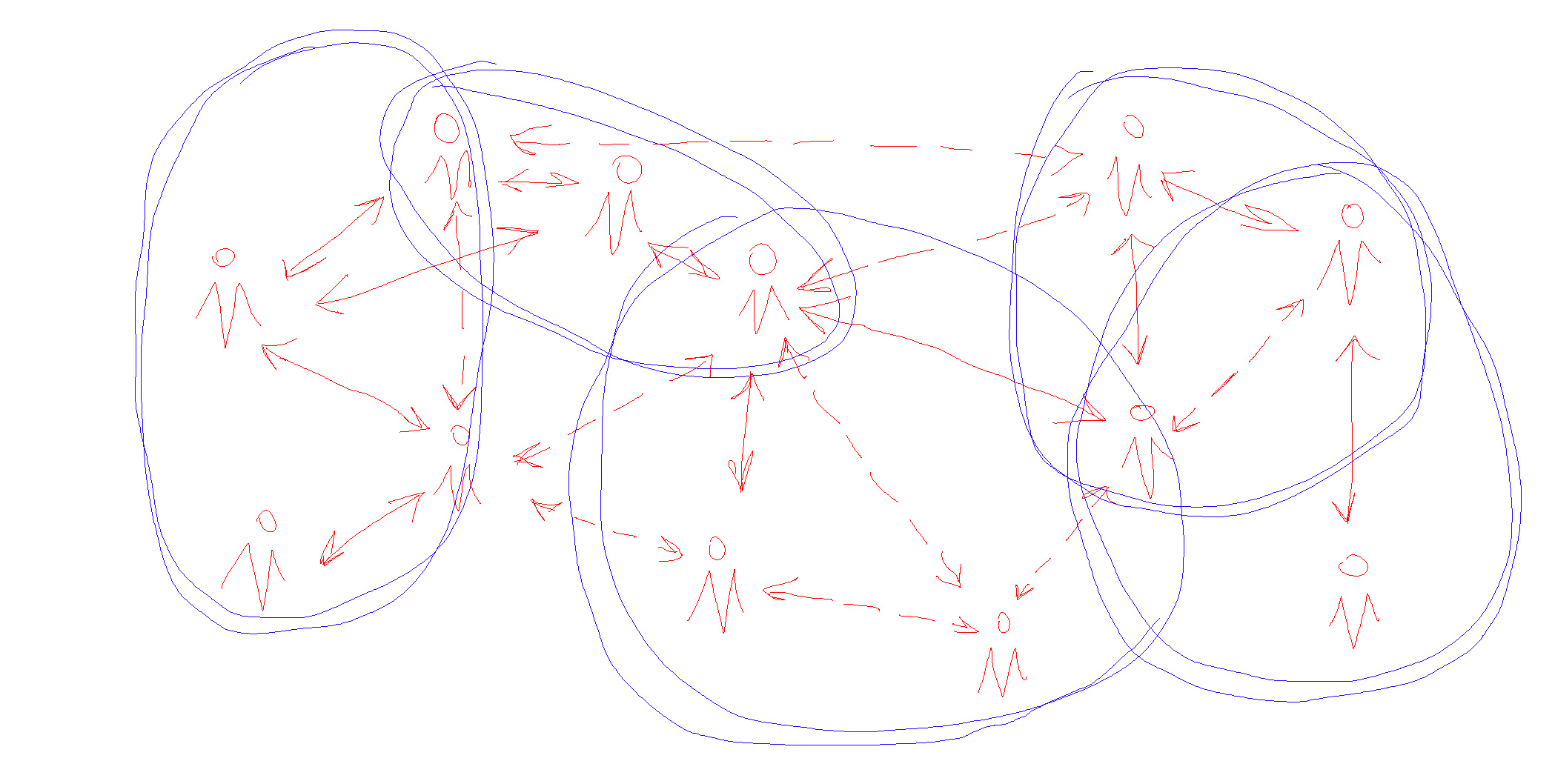
And here’s what teamwork sometimes looks like: each department is on its own, with its own goals and its own way to reach them.
But it should look different: the team has one shared goal. Everyone moves toward it in sync and understands what is expected from them at any moment. To see this goal clearly, people need to take a reflective position — step back and look at their work from the outside.

So what’s the real difference between these two pictures? In the “right” one, at Point A the team first builds a shared view of:

  • the single context of the company;
  • how departments connect and communicate to each other;
  • what roles people play inside departments.

Only then does everyone start to shape Point B — and design the context they want to end up in.

Planning the future: small company vs. big company

The approach differs depending on how many resources you have.

A product with limited resources A product with a lot of resources
Often follows external trends. Treats the existing context as the “rules of the game” for the next year. Can hold a position longer and set the context for the whole market. Often builds strategy for 3–5–10 year.

Take Elon Musk’s Neuralink: a chip implanted in the head that lets you control a computer with your thoughts. It has been tested on paralyzed people — and it works. It’s possible that in 10, 20, or 30 years many of us will use such chips. Musk is shaping the context we may all live in.

A key step: define Point A metrics through a company funnel

An important part of the session is to define your current metrics at Point A. The easiest way is a shared company funnel, where each conversion is owned by a specific department. Even if the company has no historical data, you can still assume a funnel to make the goal measurable.

Seeing the company as a funnel helps you consistently generate projects that improve conversion at each level. This is a very simplified version — in reality, the funnel is much bigger.

When the funnel is ready, you can focus on three things:

1. Create a list of projects that can significantly improve conversion between stages and key metrics. These are not just operational tasks — they are new initiatives. For example: a new client acquisition approach, a new market segment, a new process.

Projects are designed for specific funnel stages. Moving stage by stage, we:

  • make sure we covered all key parts of the business, which helps us generate more ideas;
  • discuss ideas tied to a specific stage, not in general terms;
  • we’ll rank the projects and focus on the ones most likely to benefit the company.

2. Check if the projects are good enough to reach the strategic goal. Maybe you need a fundamental shift and must rethink how the system works.

Example: when I built an office rental service, we started with an ad-based model. At some point, we realized it couldn’t scale results fast enough. We created a new approach that didn’t exist in the market: we began closing brokerage deals remotely. The company increased revenue 5x in two years.

3. Define success metrics. Founders might name top-level numbers — revenue, market share, etc. Then the team builds the funnel from the bottom up and clarifies how each department will move toward the goal.

Only after the ideal outcome is defined can we move on to a real plan and concrete steps. It answers one question: “What exactly do we need to do to get to point B?”

How Shchedrovitsky’s approach turns strategy into results

The approach fits into four steps.

Step 0. Build a map for a new project

If you already found your market, go to the next step. But if you’re planning a big, long project (3–5 years), first map it and answer key questions:

  • What future does the organization want to live in, and how do you see it?
  • Can the organization design that future?
  • How does the organization act, and what is its role?
  • How does the organization deliver value — what problem does it solve?

Step 1. Think of your project as a funnel

Map the business as a funnel, align on one North Star Metric so everyone shares a clear view of what matters most.

Step 2. Each department prepares in advance

Each department:

  • describes the context, object, and role of key people in deparment;
  • fills in Point A data for its part of the funnel;
  • prepares a plan with obvious solutions to save time during group discussion.

Step 3. Run a shared meeting

First you set the overall frame for the session. Then each department presents its Point A and Point B.

Then the team describes the projects at a high level so everyone understands their purpose and value in the same way. At this stage, we don’t go into details, so we don’t spend too much time discussing one idea. During other teams’ presentations, people add important facts and clarifications, and if you already have a working business model, this kind of discussion usually takes about 95% of the whole strategy session. If you’re just starting out, you’ll spend more time defining point B.

In the end, you get a table of potential projects for each department.

Six principles and a quick glossary

Before we go into each principle, let’s align on terms.

Imagine a factory line. Today it is assembled as-is — that’s Point A. In a year, it should run faster and more stable — that’s Point B. Each machine has an input, output, and a handover point. If you mix up operations, the line stops. If you set the handover and order correctly, speed and quality grow.

Teams work the same way: we take work from neighbors, do our part, hand it over — and we can see where effect is lost on the path from Point A to Point B. Sometimes you just need better handover discipline. Sometimes you need to rebuild part of the “line” so the move to Point B can really start.

Term Definition Example
Points A and B A is the current state; B is the desired state. Average client launch time is 120 days (A). Target is 90 (B). The team forecasts, rebuilds the process, and agrees on cross-team projects to hit the goal.
Context The situation in which the company’s activity unfolds. Sales and marketing saw the situation differently. After discussing the shared context, they built a fuller picture of where the company stands and how to use trends.
Person A person’s role inside the organization, visible as a network of connections in real work. The marketing head could invent and test new acquisition methods, but had no time because of operations. After defining their Point A and Point B, the team created a project to reorganize that person’s work.
Reflective position An “above the action” position: stepping out of your role, context and organisation. Marketing takes traffic and outputs qualified leads → sales takes leads and outputs a service package → the client starts using the product.
Action position Participants come ready to take responsibility for execution, not just dream or complain. “Let’s build an AI support bot: it can solve 60% of tasks while keeping NPS as high as with humans support. I know how to start.”
Self-movement Internal activity and motion of a system or person. Management is only possible when there is self-movement. Anton is interested in AI and product and has suggested ideas. He may be ready to lead a project that matches his interests.
Management Influencing a moving object by using its own movement to reach the organization’s goal. We choose a project and check it supports the goal. Knowing the trajectory of self-movement, we adjust course so the project doesn’t drift away.
Work assembly How scattered tasks become one flow from request to result. Request → qualification → demo → proposal → contract → launch, with named owners.
Schematization Putting the situation on a board as a scheme. It helps build a shared language: key elements, connections, and how the scheme links to the goal. The goal was higher margins. When the acquisition system was mapped, it became clear current channels can’t deliver clients at the needed cost. The team invented a new acquisition method.
Organization / object Describing how elements are assembled into a whole and what connections bind them. In sales, a Business Developer did partners + closing + client support. Two problems: losing clients when BD quits; hard to measure BD efficiency. After analysis, the team split roles: SDR (attraction), BD (signing), Accounting (relationship growth).
Owner The person accountable for a specific area and its metric. Sales lead owns qualification.

Principle 1. The future isn’t something that happens — it’s made from the position you choose to take

Core idea. You don’t need to guess the future — you can build it. To do that, you take and hold a position to “pull” the market into the reality you want (think Nike and sports culture, or Amazon and one-day delivery). The team chooses Point B and acts instead of chasing trends. This matters even more in the AI era, where new norms are still being set — and the future belongs to those who set them.

Business questions it answers

  • What position do we hold so the desired future becomes real?
  • What external conditions can we use to our advantage?
  • What opportunities and projects must we create to “bring” the future closer?
  • What should we refuse to avoid chasing hype?

How it works in the session

  • Fix Point A and construct Point B.
  • Map key elements of the future reality: the company’s core purpose, the rules of the game, critical assumptions.
  • Turn the position into strategic “yes/no” choices and a set of key projects.
  • Align departments into one movement toward Point B.

Impact

  • The team stops chasing trends and starts setting new rules in its niche.
  • Functions align into one trajectory, reducing waste.
  • Focused action speeds up results.

Principle 2. Reflection is a position “above” action

Core idea. Stepping above operations lets you see the activity map, the gaps between Point A actions and Point B goals — and then build a focused plan.

Business questions

  • Are we doing the wrong things right now? What is truly priority?
  • Which processes and projects are “weeds” that must be removed?
  • Which market signals matter — and what should we ignore to stay on course?

How it works

  • Set the time horizon: how far ahead you plan.
  • Look at the company across organization, people, and context. Fix Points A and B across these layers.
  • Identify gaps and form projects needed to close them.

Impact

  • Better prioritization, less operational noise.
  • Less wasted time and money; the Point B vector stays clear.
  • Plans become concrete and doable.

Principle 3. You can manage only what is already moving

Core idea. Any project is based on self-movement. Management is trajectory correction — you can’t manage something static. In the session, we look at how departments and leaders actually move: where initiatives go, what motives drive them, and where movement needs adjustment.

Management is only possible when something is moving—only then can we correct its direction.

Business questions

  • Where is the self-movement of each department and key person directed?
  • Which projects steer that movement — and do they lead to company goals?
  • What must be tuned or replaced so movement goes the right way?

How it works

  • Analyze current and desired positions, review ongoing initiatives, plan new ones.
  • Build projects that set the right direction frame.
  • Agree what self-movement matches Point B, and what must change.

Impact

  • You find inertia and “dead zones” faster and focus efforts where there is real traction.
  • Teams become more proactive and autonomous.
  • If a department’s trajectory conflicts with Point B, it becomes clear where adjustments are needed.

Principle 4. Schematization moves the situation to the board — so reality becomes clear.

Core idea. A shared picture is born on a scheme. A scheme forces you to be precise and fix the essence without long speeches. That reduces misinterpretation and speeds up alignment.

Business questions

  • What is the company’s core position — and what reality are we building on purpose?
    – Where is it a task (solvable inside the current structure) vs. a problem (needs structural change)?
  • If we can describe Point B, why aren’t we there yet?
  • Which dependencies between functions are critical? What must be rebuilt from scratch?
  • How do we measure success, and what are the decision boundaries and rules?

How it works

  • Put the situation on the board: objects, connections, forces, shared terms.
  • Add rules, constraints, critical assumptions; mark disputed areas.

Impact

  • One shared meaning and “rules of the game,” fewer conflicts.
  • Faster decisions, cheaper coordination.
  • Clearer prioritization: resources go to key elements, not noise.
  • Less rework: the scheme becomes a reference for process and communication design.
  • More stability in turbulence: the scheme is an anchor for adjustments.

Principle 5. View the situation in layers — context, organization, person

Core idea. A situation has multiple layers. To manage it, you must see context, the organization’s structure, and real people with their self-movement — and connect these layers to one goal.

Business questions

  • Which contextual limits and opportunities define the playing field?
  • How are processes, roles, and resources built — and do they match Point B?
  • Where do gaps between layers appear?
  • Which changes in one layer will create the biggest effect in others?

How it works

  • For each department, create a 3-column table: Points A and B for context, organization, person.
  • Identify gaps and causes; mark contradictions and hidden assumptions.
  • Form projects that stitch layers together (rules, processes, roles, incentives). Decide what must be rebuilt from scratch.
  • Set local KPIs/OKR per layer and cross-layer metrics (funnel conversions).

Impact

  • Better cross-functional initiatives, because teams understand each other through joint discussion.
  • Stronger ownership of goals: people see their impact on the whole.
  • Faster root-cause discovery (not just symptoms).
  • Management becomes systemic, not firefighting.

Principle 6. Company activity exists on four levels: operations, projects, programs, ideas

Core idea. Any activity stands on the level of ideas. Ideas define what we do, why, and why it matters. Major results and key changes are not achieved at the operational level. So in a strategy session, we work at least at the project level — ideally at the program level.

Business questions

  • At what level are we solving the problem now — and why are we stuck there?
  • What must move from operations to project or program level to create a breakthrough?
  • Where do we lack ideas or a conceptual frame for meaningful decisions?
  • How do we measure progress and effect at each level — alone and together?
  • Which decisions fail because levels are mixed up, and how do we fix it?

How it works

  • Introduce shared terminology for levels and label all initiatives.
  • Review the portfolio: mark the current and target level for each initiative.
  • Identify program tracks for 6–18 months with owners and shared metrics.

Impact

  • Operations stop eating strategy; focus stays on what matters.
  • Nonlinear shifts appear through program effects and capability building.
  • A shared mission and strategic narrative form.
  • Resource planning improves across time horizons and decision levels.
  • The organization learns faster: good solutions become standardized and scaled.

How the strategy session runs

Before the session: departments prepare materials

Each department creates a presentation where it:

  • describes its activity;
  • explains its part of the funnel;
  • shows which projects were done and how they changed the funnel.

For companies launching a new project with a long planning horizon, the main goal at this stage is to agree what will be done at all. Only then does it make sense to discuss preparation in detail.

During the session: two offline days

Early start. One big wall for schemes and flipcharts. A screen for presentations. We work in blocks with short pauses to process.

Day 1: build a shared picture. Each department shows Point A, Point B, and its plan. Other teams add their understanding and propose projects.

Day 2: continue presentations and project discussion. At the end, we summarize: everyone can share impressions and highlight projects they believe are strategically critical.

After the session: build an open backlog and align plans

Each department builds an open backlog and prioritizes projects. Then there is a setup meeting: each team presents its plan for the next quarter and the projects it will deliver.

After the quarter ends, you run another meeting to review the results:

  • check how the department’s funnel metrics changed;
  • see blockers and delivery speed for each department;
  • if new projects appeared during the quarter, assign priorities and, if needed, take them into work;
  • each department builds the next quarter plan.

What you will have after the session

  • A single movement map: how it is now → how it should be.
  • A target scheme of how the company should be structured.
  • One prioritized list of tasks with owners and metrics.

How I can help your team

For the past several years, I’ve been systematically studying the work of Russell Ackoff and Georgy Shchedrovitsky. I earned an MBA and studied at Stanford and Berkeley. I’ve been applying this foundation in practice for the last seven years, facilitating strategic sessions for both B2B and B2C projects. A typical group ranges from five to forty participants.

If the approach described in the article resonates with you, you can run a strategy session on your own—this page includes everything you need. If you’d like support, I’m ready to guide you step by step.

Earlier Ctrl + ↓